
- All
- Product Name
- Product Keyword
- Product Model
- Product Summary
- Product Description
- Multi Field Search
 |


| Quantity: | |
|---|---|
Fiberglass Reinforced Plastic, commonly known as FRP, represents a cornerstone of modern construction and manufacturing. Available in convenient roll formats, this composite material combines the strength of glass fibers with the versatility of polymer resins. The result is a product that is not only incredibly durable and resistant to environmental factors but also remarkably adaptable to a wide array of applications. From protecting the interior walls of bustling commercial kitchens to forming the sleek exterior of electrical enclosures, FRP in rolls offers a practical and efficient solution. This guide delves deep into the specific dimensions available—namely 1.2mm FRP, 1.5mm FRP, 2mm FRP, 2.5mm FRP, and 3mm FRP thicknesses, paired with widths like 1800mm FRP, 2000mm FRP, 2200mm FRP, 2400mm FRP, and 2600mm FRP—and explores how these variations cater to diverse project needs.
The thickness of FRP sheeting is a critical factor that directly influences its structural integrity, flexibility, and suitability for specific tasks. Manufacturers offer a graded spectrum to ensure there is an optimal choice for every requirement.
The thinner gauges in the FRP family, 1.2mm FRP and 1.5mm FRP, are prized for their excellent balance of strength and flexibility. These rolls are relatively lightweight, making them easier to handle and install, especially on large vertical surfaces like walls. The 1.2mm FRP is often selected for applications where weight is a concern or where the material needs to conform to slight undulations in the substrate. The 1.5mm FRP provides a slight bump in rigidity and impact resistance, making it a versatile choice for standard wall paneling in clean rooms, bathrooms, and food processing areas where hygiene and easy cleaning are paramount. Both thicknesses are ideal for direct slicing and application as decorative or protective wall cladding.
Serving as a popular middle-ground option, 2mm FRP is arguably one of the most commonly requested thicknesses. It offers a significant enhancement in durability and a stiffer feel compared to its thinner counterparts, without becoming overly cumbersome. This makes 2mm FRP sheets exceptionally versatile, suitable for both wall and ceiling installations, as well as for fabricating into sturdier items like signage backings or lightweight partitions. Its resistance to moisture, mold, and chemicals remains high, securing its position as a go-to material for demanding environments that require a robust yet workable solution.
For projects demanding maximum durability and structural contribution, the heavier gauges come into play. 2.5mm FRP is engineered for high-traffic areas or applications where the panel may face frequent impact or abrasion. It provides superior flatness and is an excellent candidate for composite panel cores. The 3mm FRP represents the pinnacle of roll-based FRP thickness in standard offerings. This heavy-duty material is less about flexibility and more about creating a solid, damage-resistant barrier. It is perfectly suited for industrial applications, heavy-use signage, security enclosures, and as a formidable substrate for exterior cladding systems where extra rigidity is non-negotiable.
Just as thickness determines performance, the width of an FRP roll dictates installation efficiency and panel layout. The availability of wide formats minimizes seams and creates a more seamless, hygienic, and aesthetically pleasing finish.
The 1800mm FRP and 2000mm FRP widths are considered industry standards, compatible with a vast majority of global construction and manufacturing frameworks. The 1800mm FRP roll is a practical choice for residential and smaller commercial projects, aligning well with common ceiling heights and wall dimensions. The 2000mm FRP roll offers greater coverage, further reducing the number of vertical joints in a typical wall installation. This not only speeds up the installation process but also enhances the waterproof and cleanable nature of the surface, a critical factor in hospitals, laboratories, and commercial kitchens.
To meet the needs of large-scale industrial and architectural projects, extra-wide rolls are available. 2200mm FRP, 2400mm FRP, and 2600mm FRP products are designed for maximum coverage and minimal waste. These widths are particularly valuable when covering large, uninterrupted surfaces such as warehouse walls, factory interiors, or big retail signage. Using a 2400mm FRP or 2600mm FRP roll can dramatically cut down on installation time and material overlap. This efficiency translates into lower labor costs and a superior final appearance with fewer seams, which is essential in creating sterile environments or sleek, modern aesthetics.
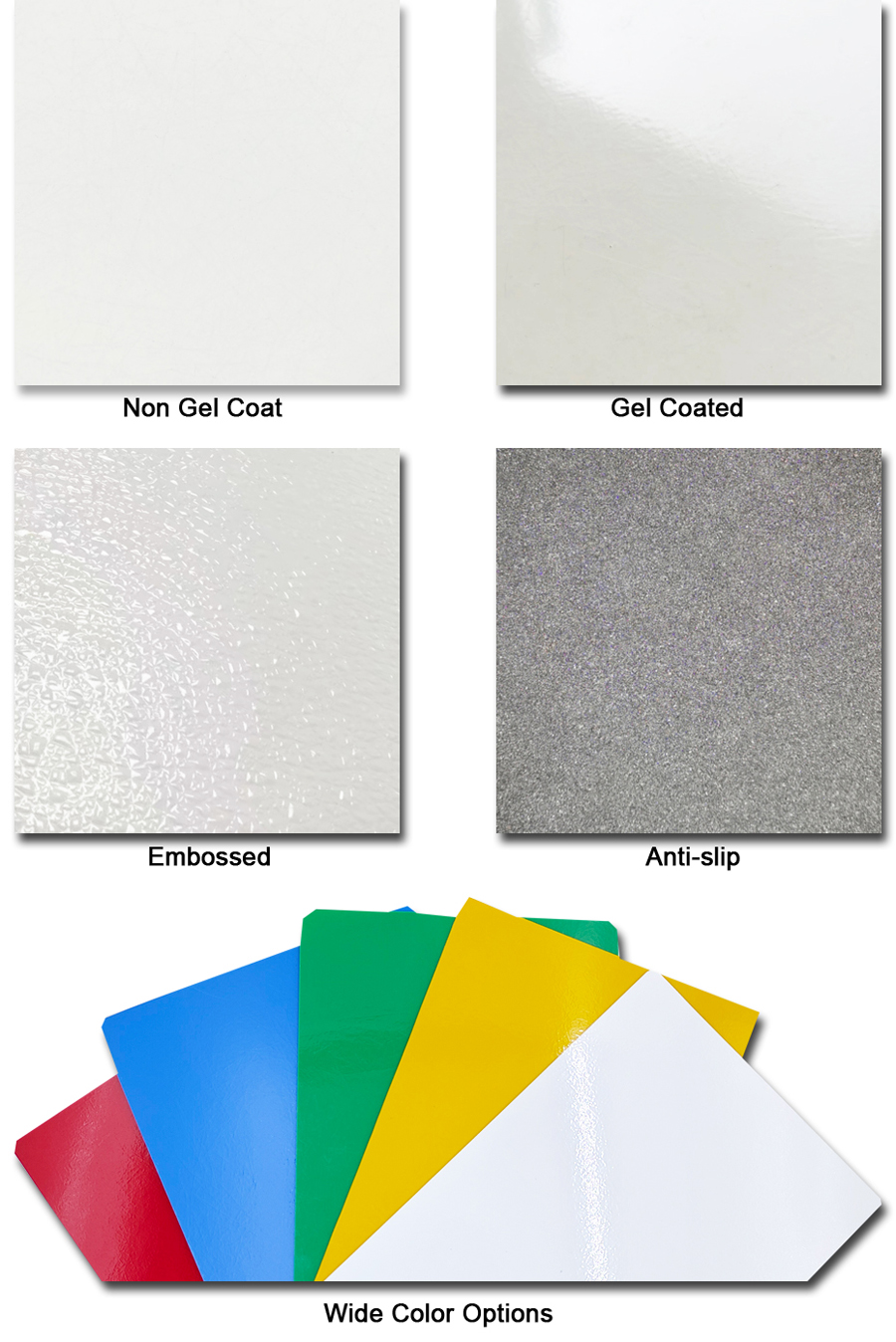
While functionality is key, aesthetics are not an afterthought with FRP. The material is naturally available in a range of colors, with white and grey being the most universal and in-demand.
White FRP is immensely popular for interiors as it reflects light, promotes a sense of cleanliness, and makes spaces appear larger. Grey FRP offers a more neutral, modern, and often less stark alternative, hiding minor scuffs better than white. These standard colors are typically ready for immediate shipment.
Beyond the standards, FRP can be manufactured in virtually any color. Custom pigments can be integrated into the gel coat layer, allowing for brand-specific blues, greens, reds, or any other hue to meet corporate design specifications or architectural visions. This makes FRP viable not just as a utilitarian panel but as an active design element.
The true power of FRP lies in its dual-mode applicability: it can be used directly as a finished sheet or as a component in more complex composites.
FRP rolls are designed for easy on-site slicing to the required length. This direct-use application is incredibly efficient.
Wall & Ceiling Cladding: Sliced sheets of 2mm FRP or 2.5mm FRP are mechanically fastened or adhered to walls in environments requiring strict hygiene, moisture resistance, and durability—think walk-in coolers, swimming pool areas, and restaurant kitchens.
Advertising Boards & Signage: The smooth, printable surface of FRP, especially in 3mm FRP thickness for rigidity, makes it an excellent substrate for outdoor and indoor advertising boards, exhibition graphics, and signage.
Electrical Enclosure Housings: Sliced and formed, FRP sheets provide a non-conductive, corrosion-resistant, and durable外壳 for electrical boxes and control panels, particularly in harsh environments.
FRP rolls serve as the perfect skin or core for engineered composite panels.
As a Durable Skin: 1.5mm FRP or 2mm FRP sheets can be laminated onto both sides of a core material (like foam, honeycomb, or plywood) to create strong, lightweight, and insulated sandwich panels used in truck bodies, modular buildings, and partitions.
Specialty Industrial Uses: Thicker 2.5mm FRP and 3mm FRP can be used in the production of industrial flooring, protective machine guards, and chemical tank linings due to their enhanced structural properties.

Selecting the correct FRP specification is crucial for project success and cost-effectiveness.
Begin by assessing the mechanical demands: Will the panel bear impact? Does it need to be rigid or slightly flexible? Answers will guide you between 1.2mm FRP and 3mm FRP. Next, consider the surface area. Opting for a 2400mm FRP or 2600mm FRP width for a large warehouse wall will save time and reduce seams compared to using a 1800mm FRP roll. Finally, choose a color that fulfills hygiene, lighting, and design requirements.
Thinner rolls are lighter and easier to maneuver but may require a more perfect substrate. Thicker, wider rolls like 2600mm FRP in 3mm thickness are heavier and may require specialized equipment for handling but offer unparalleled durability and coverage. Always ensure that the chosen dimensions are compatible with your transport and on-site access limitations.
FRP in rolls is more than just a building material; it is a highly customizable system that bridges the gap between raw material and finished application. The precise availability of thicknesses from lightweight 1.2mm FRP to rugged 3mm FRP, combined with widths spanning from standard 1800mm FRP to expansive 2600mm FRP, provides architects, contractors, and manufacturers with unparalleled flexibility. Whether you are directly slicing a roll of white 2mm FRP for a hospital wall or laminating grey 2.5mm FRP onto panels for a fleet of food trucks, this material delivers consistent performance. Its resistance to elements, ease of maintenance, and growing range of aesthetic options ensure that FRP remains a fundamental and future-proof solution across countless industries. By understanding the specific role of each thickness and width, you can strategically specify the exact FRP product that delivers optimal performance, efficiency, and value for your unique project.
Contact us:
Email: lzpanels@163.com
WhatsApp/Wechat: 008613702432446


