
- All
- Product Name
- Product Keyword
- Product Model
- Product Summary
- Product Description
- Multi Field Search
 |


| Quantity: | |
|---|---|
Fiber Reinforced Plastic (FRP) flat sheets represent a significant advancement in modern construction and industrial manufacturing materials. These versatile composite panels consist of a polymer matrix reinforced with fibers, typically glass, resulting in an exceptional combination of strength, durability, and lightweight properties. Available in various thicknesses—including 1.2mm, 1.5mm, 2mm, and 3mm—and multiple standard colors such as yellow, blue, black, gray, and white, FRP flat sheets offer unparalleled design flexibility and functional performance. The primary application driving their popularity is their use as facing materials in the production of high-performance sandwich panels. This comprehensive guide will explore the technical specifications, applications, and benefits of using these specific FRP sheets, answering the most pressing questions for architects, engineers, and fabricators.
An FRP flat sheet is a composite material made by embedding glass fibers in a thermosetting polymer resin, most commonly polyester or vinyl ester. This manufacturing process creates a sheet that is remarkably strong, chemically resistant, and dimensionally stable. The "flat" designation distinguishes it from corrugated or textured FRP panels, indicating a smooth surface that is perfectly suited for lamination. When we refer to an FRP flat sheet for sandwich panel construction, we are describing its role as the durable, protective outer skin that is bonded to a lightweight core material. This combination results in a composite structure that leverages the strengths of both materials: the FRP skin provides tensile and compressive strength, impact resistance, and a protective barrier, while the core material provides insulation, shear strength, and a significant reduction in overall weight.
The fundamental principle behind a sandwich panel is akin to an I-beam. The two thin, stiff FRP flat sheets act as the flanges, carrying the bending loads, while the thick, lightweight core material acts as the web, resisting shear forces and stabilizing the faces. This synergy allows sandwich panels to achieve very high stiffness-to-weight and strength-to-weight ratios. Using a 1.2mm FRP flat sheet or a 1.5mm FRP flat sheet as the facing can produce a panel that is as rigid as a much thicker, solid material but at a fraction of the weight. This makes them ideal for applications where weight savings are critical, such as in mobile homes, transportation vehicles, and prefabricated structures.

One of the most significant advantages of our FRP flat sheet products is their exceptional compatibility with a wide array of core materials. This versatility allows engineers to tailor the sandwich panel's properties to meet the exact requirements of a specific project.
PU Foam (Polyurethane): When bonded to an FRP flat sheet for sandwich panel cores made of PU foam, the result is a panel with outstanding thermal insulation properties. PU foam has a closed-cell structure and one of the highest R-values per inch among common insulating materials, making it a top choice for cold storage facilities, refrigerated trucks, and energy-efficient building envelopes.
XPS Foam (Extruded Polystyrene): XPS foam offers high compressive strength and excellent moisture resistance. Sandwich panels featuring XPS cores and a durable gray FRP flat sheet or white FRP flat sheet are frequently used in architectural cladding, floor underlayment, and roofing systems where moisture management is a concern.
EPS Foam (Expanded Polystyrene): EPS is a cost-effective and versatile foam core. Panels made with EPS and a blue FRP flat sheet or yellow FRP flat sheet are lightweight and provide good thermal insulation, commonly used in construction for walls and partitions.
Plastic PP Honeycomb: Polypropylene honeycomb is an ultra-lightweight core that offers exceptional compressive and shear strength. A 2mm FRP flat sheet laminated to a PP honeycomb core creates an incredibly strong yet lightweight panel used for portable structures, partitions, and decorative elements that require high rigidity.
Aluminum Honeycomb: For the most demanding applications requiring maximum strength and fire resistance, aluminum honeycomb is the preferred core. A 3mm FRP flat sheet paired with an aluminum honeycomb core yields a panel with an exceptional strength-to-weight ratio, used in aerospace, marine, and high-performance architectural applications.
Plywood: Using plywood as a core provides a sturdy and economical panel with good screw-holding capability. A black FRP flat sheet laminated to a plywood core creates a robust, impact-resistant panel suitable for truck bodies, container linings, and industrial work surfaces.
Gypsum Board: For fire-rated applications, a gypsum core is ideal. When encapsulated with an FRP flat sheet, the panel gains durability and moisture resistance, making it suitable for interior walls and ceilings in environments like hospitals, laboratories, and commercial kitchens where hygiene and fire safety are paramount.
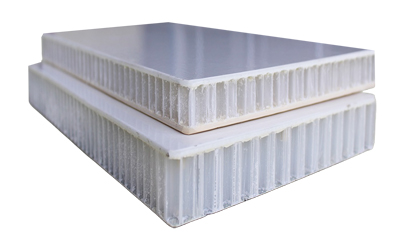
The thickness of the FRP flat sheet is a primary determinant of the final sandwich panel's mechanical properties, including its stiffness, impact resistance, and surface flatness.
The 1.2mm FRP flat sheet is the thinnest option, offering a perfect balance between performance and economy. It is designed for applications where the panel will be supported by a frame or where the core material itself provides significant structural contribution. This thickness is ideal for:
Interior wall and ceiling panels.
Non-structural architectural facades.
Lining for trailers and containers where weight is a critical factor.
Backing for signage and displays.
Often considered the workhorse of the industry, the 1.5mm FRP flat sheet provides a noticeable increase in rigidity and durability over the 1.2mm variant without a substantial weight or cost penalty. It is the most commonly specified thickness for a wide range of general-purpose applications, including:
Exterior building cladding and soffits.
Partition walls in commercial and industrial settings.
Cleanroom and food-processing area walls.
Truck body liners and van interiors.
When a project demands greater mechanical strength and resistance to impact, the 2mm FRP flat sheet is the optimal choice. The additional thickness significantly increases the panel's ability to withstand point loads and harsh handling. Key applications include:
Industrial flooring and work platforms.
Heavy-duty truck and container flooring.
Machine guards and industrial enclosures.
Panels subject to frequent cleaning or physical contact.
The 3mm FRP flat sheet represents the premium option for the most demanding environments. This thickness delivers superior stiffness, impact resistance, and an exceptionally flat surface. It is specified for applications where structural integrity is non-negotiable:
High-stress structural panels in marine vessels.
Bullet-resistant panels (when combined with appropriate cores).
Specialized industrial equipment and heavy machinery housings.
High-traffic architectural features.

The color of an FRP flat sheet is not merely an aesthetic choice; it is integral to the panel's functional performance, particularly in terms of light reflectance, heat absorption, and hygiene.
The white FRP flat sheet is the premier choice for applications requiring a clean, bright, and sanitary appearance. Its high light reflectance improves interior illumination, reducing energy costs. It is non-porous and easy to clean, making it indispensable in:
Food and beverage processing plants.
Pharmaceutical manufacturing facilities.
Hospitals, clinics, and laboratories.
Cold storage rooms where maximum light reflection is desired.
A gray FRP flat sheet offers a more neutral and professional appearance, often preferred in commercial and office environments. It helps to conceal minor dirt and smudges better than white panels, making it a low-maintenance option for:
Office partitions and interior wall systems.
Elevator interiors.
Retail store fixtures and displays.
Industrial settings where a subdued finish is preferred.
Blue FRP Flat Sheet: The blue FRP flat sheet is often used for color-coding in industrial facilities or to create a specific aesthetic in architectural designs. It is also common in aquatic or recreational settings.
Yellow FRP Flat Sheet: Safety and visibility are the key drivers for the yellow FRP flat sheet. It is used for safety barriers, warning panels, industrial machinery housings, and in any area where high visibility is necessary for safety protocols.
Black FRP Flat Sheet: The black FRP flat sheet is chosen for its aesthetic appeal in modern design and its ability to absorb light. It is used for architectural features, exhibition stands, and specialized equipment where a dark, non-reflective surface is required.
A: Our FRP flat sheets are typically produced in large, continuous coils or large-format sheets, which can be cut and tailored to your specific requirements. Standard widths can range up to 3 meters or more, allowing for the production of very large, seamless sandwich panels, which minimizes joints and improves both the aesthetic and performance integrity of the final installation.
A: The lamination process is critical to the performance of the sandwich panel. It typically involves using a high-strength structural adhesive applied evenly to the core material. The FRP flat sheet is then pressed onto the core under controlled heat and pressure. This process, often done in a continuous or batch press, ensures a full, uniform bond that effectively transfers stresses between the skin and the core, guaranteeing the panel's structural integrity.
A: While our FRP flat sheets, such as the white FRP flat sheet or gray FRP flat sheet, come with a permanent, molded-in gel coat finish that is highly durable and requires no painting, they can be painted if a specific color match is needed. Surface preparation is key and typically involves light abrasion and the use of a primer designed for bonding to polyester or vinyl ester surfaces.
A: Sandwich panels made with our FRP flat sheets are designed for exceptional longevity. They are resistant to rot, corrosion, and a wide range of chemicals. With proper installation, they can last for decades. Maintenance is straightforward, typically requiring only periodic cleaning with mild soap and water to maintain their appearance. The non-porous surface of a white FRP flat sheet or blue FRP flat sheet prevents the growth of mold and mildew, further reducing maintenance needs.
Choosing the correct FRP flat sheet for sandwich panel production is a decision that directly impacts the performance, cost, and success of your project. By understanding the interplay between thickness, color, and core material, specifiers can engineer a composite solution that precisely meets their structural, insulation, aesthetic, and budgetary goals. Whether you require the lightweight efficiency of a 1.2mm FRP flat sheet, the robust durability of a 3mm FRP flat sheet, the hygienic properties of a white FRP flat sheet, or the safety signaling of a yellow FRP flat sheet, our product range offers the flexibility and quality needed for the most demanding applications. By partnering with a knowledgeable supplier, you can leverage the full potential of this advanced composite material to create innovative and long-lasting structures.
Contact us:
Email: lzpanels@163.com
WhatsApp/Wechat: 008613702432446


