
- All
- Product Name
- Product Keyword
- Product Model
- Product Summary
- Product Description
- Multi Field Search
 |


| Quantity: | |
|---|---|
The commercial transportation industry is in a constant state of evolution, driven by demands for greater efficiency, durability, and payload optimization. At the forefront of this revolution is Glass Fiber Reinforced Plastic (GFRP), a composite material redefining how modern truck bodies, especially refrigerated and dry freight containers, are engineered and manufactured. Unlike traditional materials, GFRP sheet offers an exceptional strength-to-weight ratio, corrosion resistance, and structural integrity, making it an indispensable component for the demanding environments of logistics and cold chain transport.
A GFRP sheet coil refers to the continuous roll form of this composite, which provides manufacturers with unparalleled flexibility in production. This format allows for efficient, large-scale fabrication of large, seamless panels, reducing waste and labor costs. When we specifically discuss a GFRP coil for truck applications, we refer to a product engineered to meet rigorous standards for impact resistance, thermal management, and long-term weathering. This guide delves deep into the specifics of grey GFRP sheet coil and white GFRP sheet coil in standard thicknesses of 1.2mm, 1.5mm, and 2mm, explaining their critical role in creating superior composite panels for the trucking industry.
A GFRP coil is a manufactured continuous roll consisting of a thermosetting resin matrix—typically polyester or vinyl ester—reinforced with layers of glass fiber. This combination yields a material that is both incredibly strong and remarkably lightweight. The "coil" format is a game-changer for industrial applications, as it enables automated, roll-forming processes and the creation of large, monolithic panels without the need for numerous seams or joints, which are potential weak points.
The primary advantages of using a GFRP sheet coil for truck body construction are multifaceted:
High Strength & Rigidity: Provides excellent structural support for wall and roof assemblies.
Lightweight: Significantly reduces the tare weight of the truck body, allowing for increased payload capacity and improved fuel economy.
Corrosion & Chemical Resistance: Impervious to rust, rot, and resistant to most chemicals and cleaning agents used in transport.
Excellent Surface Finish: Offers a smooth, hard, and aesthetically pleasing surface that is easy to clean and maintain.
Dimensional Stability: Maintains its shape and integrity across a wide range of temperatures and humidity levels.

Choosing the correct thickness is paramount to achieving the optimal balance between performance, weight, and cost. The three most prevalent standards—1.2mm GFRP sheet coil, 1.5mm GFRP sheet coil, and 2mm GFRP sheet coil—each serve distinct purposes in composite panel construction.
The 1.2mm GFRP sheet coil represents the lighter-duty option within the standard range. Its primary application is as the interior skin of a composite sandwich panel. When bonded to an insulating core like XPS, PU, or EPS, the 1.2mm thickness provides a smooth, durable, and hygienic interior lining that is perfectly adequate for the controlled environment inside the trailer. Its thinner profile contributes directly to weight savings. It is also a cost-effective choice for applications where the ultimate panel rigidity is derived from a thicker external skin and the core material itself.
The 1.5mm GFRP sheet coil is arguably the most versatile and widely used thickness. It serves as an excellent balanced choice for both interior and exterior applications in many trailer designs. As an exterior skin, it provides robust impact resistance against road debris, minor collisions, and handling during loading/unloading. As an interior skin, it offers enhanced durability over the 1.2mm variant. For many standard dry freight and refrigerated trailers, using a 1.5mm GFRP sheet coil for both the inner and outer skins creates a panel that is strong, reliable, and optimally priced.
For the most demanding applications, the 2mm GFRP sheet coil is the go-to solution. This thickness is primarily specified for the exterior skin of trailers that operate in extreme conditions—such as long-haul international routes, rough terrain, or harsh climatic zones. The additional thickness dramatically increases impact resistance, overall panel stiffness, and longevity. A trailer clad with a 2mm exterior GFRP sheet can better withstand the punishing effects of weather, UV exposure, and physical abuse over a decade or more of service, making it a premium choice for high-value fleets.
The color of the GFRP sheet coil is not merely an aesthetic decision; it has significant functional implications for the performance and efficiency of the truck body.
A white GFRP sheet coil is the predominant choice for refrigerated (reefer) truck bodies and many dry vans. The reason is rooted in thermal science. White surfaces have a very high Solar Reflectance Index (SRI), meaning they reflect a large percentage of solar radiation rather than absorbing it as heat. When used as the exterior skin, a white GFRP surface can significantly reduce the radiant heat load on the trailer. This translates directly into lower energy consumption for the refrigeration unit, as it does not have to work as hard to maintain the required internal temperature. This leads to fuel savings for the tractor and reduced wear on the reefer unit.
A grey GFRP sheet coil offers a more neutral, often corporate, aesthetic and is valued for its ability to hide dirt and surface scuffs better than a bright white finish. While it absorbs more heat than white, modern insulation cores are highly effective at mitigating this effect. The grey pigment can also offer enhanced UV stability in some formulations, contributing to long-term color retention and material integrity. It is a popular choice for dry freight applications where brand colors or a specific fleet appearance is desired, and the thermal reflectivity is a secondary concern to aesthetics and perceived cleanliness.
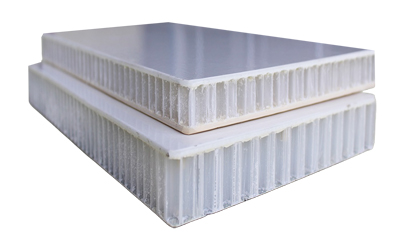
The true potential of a GFRP coil for truck body is realized when it is used as the facing skin in a structural sandwich panel. The GFRP skins provide tensile and compressive strength, while the core material manages shear stress and provides insulation.
XPS (Extruded Polystyrene): Offers high compressive strength and excellent, consistent thermal resistance (R-value) with very low water absorption. Ideal for high-moisture environments and floors.
PU (Polyurethane): Provides the highest R-value per inch of any common core, allowing for thinner, lighter walls with superior insulation. It bonds excellently to GFRP, creating a very strong monolithic panel.
EPS (Expanded Polystyrene): A cost-effective insulation core with good thermal properties. It is lighter than XPS but has lower compressive strength and higher water absorption potential.
PP Honeycomb (Polypropylene Honeycomb): While not an insulator, PP honeycomb offers an extremely high strength-to-weight ratio. Panels with GFRP skins and a PP honeycomb core are incredibly rigid and light, perfect for ultra-lightweight dry van bodies or internal structures where insulation is not required.
The selection of a 1.2mm, 1.5mm, or 2mm GFRP sheet coil must be made in conjunction with the core type and thickness to achieve the target panel performance for load-bearing, insulation, and durability.
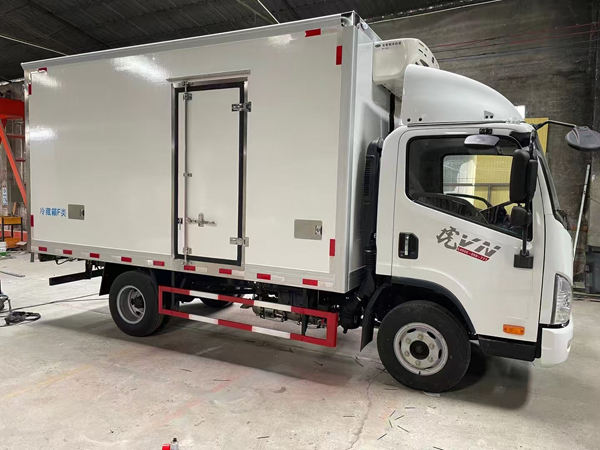
For refrigerated trailers, the selection of GFRP sheet coil is critical to thermal efficiency. The standard construction often involves a thicker exterior skin (e.g., 1.5mm or 2mm GFRP sheet coil) in white to maximize solar reflectivity, paired with a thinner interior skin (e.g., 1.2mm or 1.5mm GFRP sheet coil), also typically in white for cleanliness. These are laminated to a thick layer of high-performance PU foam. This combination creates a panel with exceptional thermal break properties, structural integrity to withstand constant compression from cargo, and a hygienic, easy-to-clean interior that meets food-grade transport standards.
Dry freight or van bodies prioritize durability, weight savings, and damage resistance. Here, grey GFRP sheet coil is frequently chosen for its aesthetic and practical maintenance benefits. Panel construction may utilize 1.5mm GFRP sheet coil for both skins with a PU or EPS core, or even a PP honeycomb core for maximum payload capacity. The toughness of the GFRP surface protects against forklift impacts, loading equipment, and the general rigors of logistics hubs, ensuring a long service life and low maintenance costs.
When procuring a GFRP coil for truck manufacturing, it is essential to specify beyond just thickness and color. Key considerations include:
Resin Type: Isopolyester for general use, or vinyl ester for enhanced chemical resistance?
Glass Fiber Type & Layup: The weight and orientation of the glass mat (e.g., continuous strand mat) affect mechanical properties.
Surface Finish: Gel coat finish for superior weather resistance vs. a plain resin-rich surface.
Coil Dimensions: Width, length per coil, and core diameter for compatibility with your roll-forming or laminating equipment.
Consulting with your GFRP sheet coil supplier to match the material specifications to your specific panel performance requirements is crucial for a successful outcome.
The advancement of composite truck bodies is inextricably linked to the development and application of high-quality GFRP sheet coil. By offering customizable solutions in 1.2mm, 1.5mm, and 2mm thicknesses, and in functional colors like white and grey, this material provides engineers and manufacturers with the tools to build lighter, stronger, and more efficient transportation equipment. Whether the goal is to maximize cubic capacity in a dry van or to achieve the lowest possible thermal conductivity in a reefer, the strategic use of GFRP coil for truck body construction delivers unparalleled performance. As logistics demands grow and sustainability becomes paramount, the role of this versatile, high-performance composite material will only continue to expand, solidifying its position as the backbone of modern commercial vehicle design.
Contact us:
Email: lzpanels@163.com
WhatsApp/Wechat: 008613702432446


