
- All
- Product Name
- Product Keyword
- Product Model
- Product Summary
- Product Description
- Multi Field Search
 |


| Quantity: | |
|---|---|
Fiberglass Reinforced Plastic (FRP) in coil form represents a pinnacle of modern industrial material innovation, offering an exceptional blend of durability, flexibility, and aesthetic versatility. This material, available in standard thicknesses of 1.5mm FRP, 2mm FRP, and 3mm FRP, and a spectrum of colors including brown FRP, black FRP, yellow FRP, red FRP, blue FRP, grey FRP, and white FRP, serves as a fundamental component across countless sectors. Supplied in convenient coils, this product streamlines logistics, storage, and handling, allowing for efficient on-site fabrication. Its unique capability to be directly sliced for immediate use or laminated into sophisticated composite panels makes it an indispensable asset for architects, designers, and engineers seeking a reliable and adaptable building solution.
The functional application of FRP coil is primarily dictated by its physical dimensions. The thickness of the material is a critical factor influencing its structural strength, rigidity, and suitability for specific environments.
The 1.5mm FRP Coil: This is the lightweight champion, ideal for applications where weight is a constraint but durability is non-negotiable. The 1.5mm FRP thickness is perfectly suited for interior wall paneling, decorative ceilings, and protective linings in controlled environments. Its flexibility in coil form allows it to conform to gentle curves and shapes with relative ease.
The 2mm FRP Coil: Striking an optimal balance between versatility and strength, the 2mm FRP thickness is the most widely used specification. It provides enhanced impact resistance and load-bearing capacity compared to its 1.5mm counterpart, making it a go-to choice for industrial wall cladding, food-grade partition walls, and robust sanitary panels in commercial kitchens and washrooms.
The 3mm FRP Coil: Engineered for demanding applications, the 3mm FRP offers maximum durability and rigidity. This thickness is specified for heavy-duty industrial settings, exterior applications requiring high weather resistance, and areas subject to significant mechanical impact or abrasion. The 3mm FRP in coil can be formed into highly resilient composite panels for demanding structural applications.
Beyond thickness, FRP coils are produced in a variety of standard and custom widths to minimize waste and adapt to project-specific designs. The coil length is another customizable variable, with manufacturers offering long continuous lengths that reduce joints and seams in the final installation, ensuring both a cleaner aesthetic and improved hygiene by eliminating crevices where contaminants can gather.

The aesthetic flexibility of FRP coil is one of its most compelling features. Beyond its functional prowess, it offers a designer-friendly palette that can meet both practical coding requirements and creative visions. Each color variant can be processed with either a glossy or matte finish, further expanding its application potential.
White FRP: The epitome of cleanliness and brightness, white FRP is a staple in healthcare, food processing, and laboratory environments. Its high light-reflectance properties help illuminate spaces, while its non-porous surface supports strict sanitary protocols. A glossy white FRP finish amplifies brightness and is easy to wipe clean, while a matte finish reduces glare.
Grey FRP: Offering a neutral, professional appearance, grey FRP is favored in modern industrial and commercial interiors. It hides minor scuffs and dirt better than lighter colors, making it a low-maintenance option for utility areas, office partitions, and clean manufacturing zones.
Blue FRP: Often associated with calm and hygiene, blue FRP is commonly used in aquatic centers, dairy facilities, and pharmaceutical areas. The color can also be used for coding purposes, such as distinguishing different process zones or safety areas within a plant.
Red FRP: This vibrant color serves critical roles in safety and visibility. Red FRP is used to mark fire safety equipment zones, emergency exits, and hazardous areas. Its high visibility makes it an important tool for implementing workplace safety protocols.
Black FRP: Sleek and modern, black FRP provides a sophisticated aesthetic for commercial interiors, retail spaces, and high-end design elements. It is also used in applications where light absorption is required or for creating visual contrast.
Yellow FRP: Synonymous with caution and visibility, yellow FRP is essential for safety markings, hazard warnings, and traffic control areas within industrial facilities. It ensures high visibility in low-light conditions.
Brown FRP: Excellent for blending with natural surroundings or creating warm, wood-like aesthetics in interiors, brown FRP is used in decorative applications, architectural facades, and environments where a less industrial look is desired.
The choice between a glossy or matte finish is functional as well as aesthetic. A glossy finish provides a smoother, more impervious surface that is exceptionally easy to clean and offers higher light reflectance. A matte finish, on the other hand, offers a sophisticated, non-reflective appearance that better conceals fingerprints and surface imperfections.
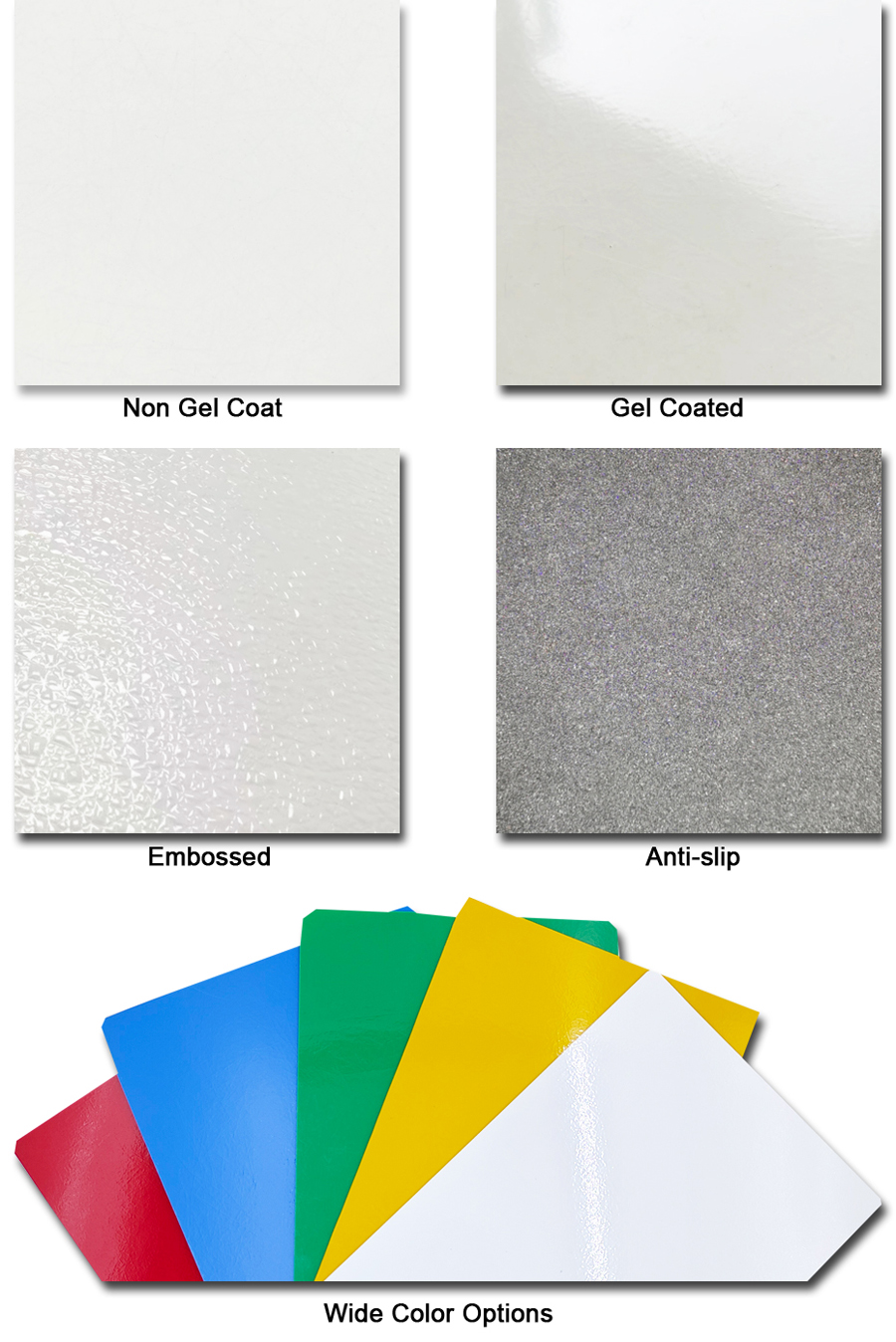
The true power of FRP in coil form lies in its remarkable adaptability in fabrication. It arrives at the job site or factory as a manageable coil, which can then be transformed through several processes.
Direct Slicing and Immediate Use: The most straightforward application involves uncoiling the material and slicing it into precise sheets or strips using standard cutting tools. These cut pieces can be directly installed as white FRP or grey FRP wall panels, yellow FRP safety barriers, or brown FRP decorative features. This method offers incredible speed and reduces pre-processing costs.
Lamination into Composite Panels (The Core Strength): This is where FRP coil demonstrates its advanced engineering value. The material acts as a superb facing skin that can be laminated onto various core materials to create strong, lightweight composite panels. Common cores include:
Honeycomb Core: For ultra-light, rigid panels used in aerospace, transportation, and doors.
Foam Core (e.g., PVC, PU, XPS): For insulation panels with excellent thermal properties, used in cold storage, building facades, and modular structures.
Plywood or MDF Core: For creating sturdy, flat architectural panels for signage, furniture, and interior construction.
The lamination process bonds the FRP coil—whether it's a vibrant red FRP or a sturdy 3mm FRP—to the core under heat and pressure, creating a monolithic panel that inherits the best properties of both materials: the chemical, moisture, and abrasion resistance of the FRP skin, and the structural or insulating properties of the core.
The combination of variable thickness (like 1.5mm FRP for lighter duties and 3mm FRP for heavy-duty needs), color options, and fabrication methods opens up a world of applications.
Architecture & Construction: Used for interior wall and ceiling cladding in hospitals, schools, and commercial kitchens (white FRP, blue FRP), exterior soffits, and as the facing for insulated architectural panels for facades.
Transportation: Fabricated into composite panels for truck and trailer liners, RV interiors, and marine bulkheads, where grey FRP or black FRP provides a durable, cleanable surface.
Food & Beverage Industry: As sanitary wall systems in processing plants, abattoirs, and breweries. White FRP and glossy finishes are dominant here for cleanability.
Cleanrooms & Laboratories: White FRP panels with glossy finishes create seamless, non-shedding, and disinfectable environments critical for pharmaceutical and electronics manufacturing.
Signage & Display: The material is easily fabricated into durable, weather-resistant signs, point-of-purchase displays, and exhibition stands, with colors like yellow FRP and red FRP used for high-impact graphics.
Industrial Safety & Hygiene: Used to create chemical-resistant workbenches, protective wall coverings in chemical plants, and color-coded safety zones using yellow FRP and red FRP.

In summary, FRP supplied in coil form—in 1.5mm, 2mm, and 3mm thicknesses across the full spectrum from brown FRP to white FRP—is more than just a sheet material; it is a flexible manufacturing platform. The ability to select the exact combination of thickness for strength, color for function or form, and finish for performance, followed by the freedom to either use it directly or engineer it into advanced composites, makes it a uniquely powerful solution. Whether specifying a sanitary white FRP wall system from a 2mm FRP coil or a structural composite using a durable 3mm FRP skin, this material continues to redefine possibilities in design and industrial manufacturing, proving that strength, beauty, and utility can indeed be rolled into one.
Contact us:
Email: lzpanels@163.com
WhatsApp/Wechat: 008613702432446


