
- All
- Product Name
- Product Keyword
- Product Model
- Product Summary
- Product Description
- Multi Field Search
 |


| Quantity: | |
|---|---|
In the world of commercial transportation, the trailer body is more than just a container; it's a meticulously engineered shell that protects valuable cargo from the elements, theft, and the rigors of the road. While many components contribute to a trailer's integrity, the choice of interior and exterior cladding is paramount. Enter the white GRP panel for trailers – a versatile, robust, and highly efficient material that has become the industry standard. This article explores the innovative application of 1.5mm and 2mm Fiberglass panel for trailers, not as a standalone monolithic structure, but as the critical facing material in sophisticated composite panel systems. We will delve into the transformative process of laminating these panels onto core materials and the subsequent assembly into the durable trailers we see on highways every day, offering a fresh perspective on this foundational component.
Before we explore its advanced applications, it's crucial to understand the base material. A Fiberglass panel for trailers, also known as a Glass Reinforced Plastic (GRP) or Fiberglass Reinforced Plastic (FRP) panel, is a composite material made by combining a plastic polymer matrix with strong, fine glass fibers. This synergy results in a panel that boasts an exceptional strength-to-weight ratio, corrosion resistance, and a smooth, durable surface. The classic white GRP panel for trailers is not just an aesthetic choice; its light-reflective properties help maintain lower internal temperatures and improve interior visibility. The two most common thicknesses for the raw facing sheet are the 1.5mm FRP panel for trailers and the 2mm FRP panel for trailers, each selected based on the specific structural and budgetary requirements of the final trailer wall system.
The true innovation in modern trailer construction lies not in using a thick, solid FRP panel for trailers by itself, but in using thinner, flexible sheets like the 1.5mm GRP panel for trailers as the facing skin for a composite sandwich panel. This approach leverages the best properties of multiple materials to create a final product that is lighter, stronger, and better insulated than any single material could be.
The performance of a trailer wall is defined by its core. The GRP panel for trailers acts as the tough, protective outer and inner skin, while the core material in the middle provides structural rigidity and thermal insulation.
PP Honeycomb Core: Polypropylene honeycomb is a lightweight, high-strength core that resembles a bee's honeycomb. It offers excellent compressive strength and is inherently moisture-resistant, making it ideal for creating panels that are both strong and exceptionally light. This is a common choice for dry freight vans where weight savings directly translate to fuel efficiency and higher payload capacity.
Various Foam Cores (XPS/ PU/EPS): For refrigerated or insulated trailers, foam cores are the gold standard. Polystyrene (PS), Polyurethane (PU) foams are expanded within the sandwich structure, creating a closed-cell matrix that provides outstanding thermal insulation (high R-value). The lamination of a 2mm Fiberglass panel for trailers to such a core creates a formidable barrier against external temperatures.
This is where the magic happens. The process of bonding a flat Fiberglass panel for trailers to a core material is a precise, industrial operation that transforms individual components into a unified, structural element.
Material Preparation: The process begins with large coils of the white GRP panel for trailers. This coil-form is a significant advantage, allowing for continuous, efficient production. The sheet is uncoiled and cut to the required length. Simultaneously, the core material is prepared—either as pre-formed PP honeycomb sheets or as liquid chemical components for foam injection.
Adhesive Application: A high-strength structural adhesive is meticulously applied to one side of the 1.5mm Fiberglass panel for trailers. The type of adhesive is critical; it must form a bond stronger than the individual materials themselves and remain stable across a wide temperature range.
Lay-Up and Pressing: The core material is carefully laid onto the adhesive-coated FRP sheet. For foam cores, the second 2mm GRP panel for trailers (which will become the interior wall) is positioned parallel, and the liquid foam components are injected into the cavity. The entire "sandwich" is then fed through a double-belt press. This press applies controlled heat and pressure, curing the adhesive (and expanding the foam, if applicable) to create a permanent, inseparable bond.
Curing and Finishing: The newly formed composite panel is allowed to fully cure, ensuring maximum bond strength. It is then trimmed to its final dimensions, and any necessary routing for assembly hardware is completed. The result is a solid, rigid panel where the 1.5mm FRP panel for trailers and the core work in perfect harmony to resist bending, buckling, and impact.
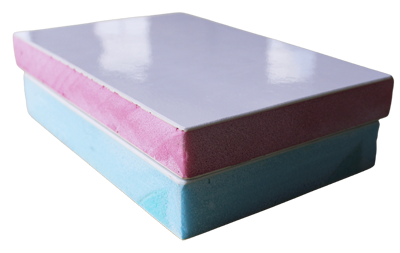
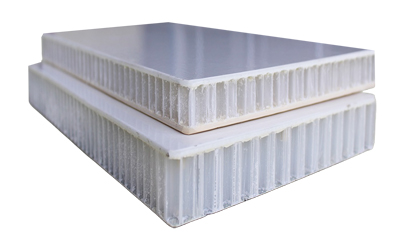
With the composite panels manufactured, the next stage is their transformation into a trailer body. This process highlights the practicality and efficiency that the FRP panel for trailers system brings to trailer manufacturers.
Trailer manufacturers receive these large, flat composite panels. Using CAD/CAM software and CNC routers, they precisely cut these panels to create the specific components of the trailer: the roof, sidewalls, front wall, and rear frame sections. The ability to precisely cut the material, which started as a coil of white GRP panel for trailers, allows for customization and high production accuracy.
Unlike unibody car construction, most trailer bodies are built on a separate, robust metal frame (typically aluminum or steel). The composite panels are then attached to this frame.
Frame Construction: The trailer's main undercarriage and side posts (studs) are assembled. These vertical and horizontal members form the skeleton of the trailer.
Panel Attachment: The pre-cut composite panels, with their 2mm FRP panel for trailers surfaces, are positioned against the frame. They are mechanically fastened to the studs using screws or rivets. In some advanced methods, adhesive bonding is used in conjunction with mechanical fasteners for a smoother interior finish and enhanced strength.
Seaming and Sealing: The joints where panels meet are critical. They are sealed with high-quality butyl tape or silicone sealants to create a completely watertight and airtight barrier. For the roof, a separate one-piece roof sheet (often a thicker GRP panel for trailers or an aluminum sheet) is often laid over the assembled structure and bonded to create a seamless, weatherproof top.
The nearly assembled box now receives its final components. Doors, landing gear, the kingpin, and lighting systems are installed. The interior, with its smooth, easy-to-clean surface of the 2mm Fiberglass panel for trailers, is prepared for the installation of logistics equipment like E-Track. For refrigerated units, the cooling unit is integrated, and its efficiency is heavily reliant on the superior insulation provided by the foam-core panels skinned with the 1.5mm GRP panel for trailers.
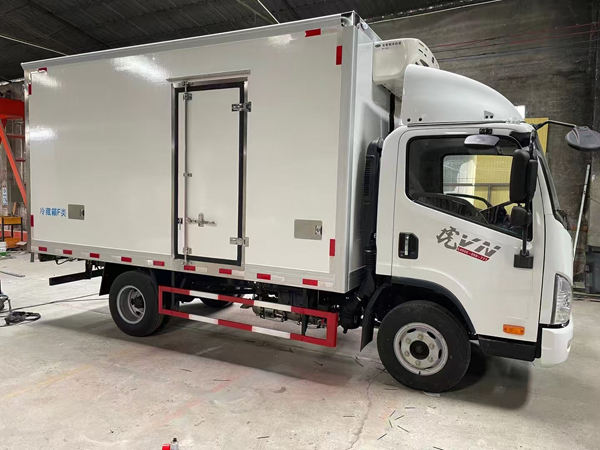
The choice between a 1.5mm Fiberglass panel for trailers and a 2mm Fiberglass panel for trailers is a strategic decision impacting performance and cost.
The 1.5mm FRP Panel for Trailers: This thinner gauge is a cost-effective and lightweight solution. It provides a perfectly adequate surface for the interior walls of dry vans and can be used as the exterior skin when the structural demands are moderate. Its flexibility is an asset during the lamination process onto curved surfaces.
The 2mm FRP Panel for Trailers: This is the heavyweight champion. The 2mm GRP panel for trailers offers significantly greater impact resistance, rigidity, and durability. It is the preferred choice for high-wear areas, for the exterior skin of trailers expecting rough handling, or for applications where the panel needs to span wider distances between frame members without flexing.
The composite panel system built around the white GRP panel for trailers is incredibly versatile.
Dry Freight Vans: For standard dry vans, the primary requirements are strength, low weight, and a clean, damage-resistant interior. A PP honeycomb or thin foam core laminated with a 1.5mm FRP panel for trailers on the interior is a perfect fit, creating a robust yet lightweight box.
Refrigerated Trailers (Reefers): For reefers, thermal efficiency is non-negotiable. Here, thick blocks of PU/PIR foam are laminated between a durable exterior 2mm GRP panel for trailers (often in white to reflect heat) and an interior 1.5mm or 2mm FRP panel for trailers. This creates a highly insulated, airtight environment crucial for protecting temperature-sensitive cargo.
The humble fiberglass panel for trailers has evolved. It is no longer just a simple wall covering but the essential facing material in a high-tech composite system. From its origins as a coil of white GRP panel for trailers to its transformation through lamination and precise assembly, this material demonstrates the power of smart engineering. By understanding the distinct roles of the 1.5mm GRP panel for trailers and the 2mm GRP panel for trailers, and the sophisticated processes that bind them to advanced cores, trailer manufacturers can continue to produce lighter, stronger, and more efficient trailers that form the backbone of global logistics. This innovative use of materials ensures that the trailers on the road today are smarter and more capable than ever before.
Contact us:
Email: lzpanels@163.com
WhatsApp/Wechat: 008613702432446


