
- All
- Product Name
- Product Keyword
- Product Model
- Product Summary
- Product Description
- Multi Field Search
 |


| Quantity: | |
|---|---|
When specifying interior wall surfaces for incubator rooms, hatcheries, and controlled-environment poultry facilities, the margin for error is narrow. Humidity stays elevated, sanitation cycles are frequent, and the wall substrate must endure years of thermal cycling without delamination, mold creep, or surface degradation. Pebbled FRP and Pebbled GRP sheet materials have become the default specification in these environments for one practical reason: they solve the moisture-and-hygiene equation better than painted metal, drywall, or traditional tile, while remaining economical enough for large-format wall coverage.
LZ Panels manufactures Pebbled Fiberglass Sheet in roll form at 1.9mm, 2mm, and 2.3mm thicknesses, with the option to pre-cut to your exact wall schedule or supply full rolls for on-site fabrication. This page outlines why the pebbled surface profile matters for incubator room interiors, how the material performs under real operating conditions, and the accessory ecosystem required for a finished, code-compliant installation.
Incubator rooms are not ordinary wet rooms. They combine continuous sensible heat loads from egg mass and equipment, near-saturated relative humidity during set and hatch phases, and strict biosecurity protocols that demand wash-down capability between batches. A wall surface in this environment must resist moisture ingress at seams and penetrations, tolerate routine disinfection with peroxides and quaternary ammonium compounds, and present a non-porous face that does not harbor organic residue.
Pebbled FRP for Walls addresses all three requirements simultaneously. The fiberglass-reinforced polyester matrix is inherently non-absorbent; water vapor does not migrate through the panel thickness. The pebbled texture—a fine, consistent orange-peel embossing rather than a deep mechanical profile—provides two counterintuitive benefits. First, it hides minor surface scuffs and handling marks that would be glaring on a gloss-smooth panel, preserving the visual standard of the room between deep cleans. Second, the micro-texture improves grip during installation when panels are handled with wet or gloved hands, reducing the risk of creasing or surface damage before the material is fastened to the substrate.
For hatchery operators standardizing wall finishes across multiple setters and hatchers, Pebbled GRP Sheet offers a consistent, repeatable surface that does not require painting, sealing, or periodic recoating. The gelcoat surface is formulated to resist yellowing under the UV output of germicidal fixtures and the general lighting loads typical in hatchery corridors.

LZ Panels produces the pebbled roll material in three thicknesses, each matched to a distinct wall condition and installation method.
Pebbled FRP 1.9mm is the lightest specification in the range and is typically selected for adhesive-set installations over smooth, dimensionally stable substrates such as plywood or cement board in retrofit situations where wall build-out is constrained. The 1.9mm sheet conforms readily to minor substrate irregularities and is manageable for a two-person crew cutting and fitting panels around door frames and equipment penetrations.
2mm Pebbled Fiberglass is the general-purpose workhorse for incubator room walls. It provides a balanced combination of stiffness and conformability: rigid enough to span minor substrate gaps without telegraphing, yet flexible enough to cut cleanly with a utility knife or fine-tooth blade on site. For rooms where panels are supplied in roll form and cut to the wall elevation, 2mm reduces waste because the material can be oriented to minimize offcuts across multiple wall runs.
Pebbled FRP 2.3mm is the heavy-duty option, specified where wall surfaces face direct impact risk from egg flats, trolley frames, or equipment movement during turnarounds. The additional thickness improves resistance to point-load denting and provides a more substantial feel under hand pressure. In rooms where the FRP is installed over furring or a framed cavity rather than direct adhesive to a solid substrate, the 2.3mm grade offers better screw-holding capacity at perimeter fastening points and resists oil-canning between studs.
The pebbled texture is often treated as a cosmetic choice. In incubator room service, it is a functional specification.
Light diffusion and inspection. Hatchery rooms are lit for candling, egg transfer, and sanitation verification. A smooth, glossy FRP surface reflects overhead fixtures in a way that creates glare zones and visual dead spots along the wall. The pebbled profile breaks up specular reflection, distributing light more evenly across the wall plane. This makes it easier for QA staff to visually inspect wall surfaces for residue or biofilm after wash-down without repositioning light sources.
Resistance to cleaning abrasion. Sanitation crews in hatcheries use foaming applicators, low-pressure rinse wands, and occasional manual scrubbing at seams and corners. A dead-smooth surface shows every pass of an abrasive pad. The pebbled embossing stands slightly proud of the base resin, so the high points take the mechanical contact while the valleys retain the continuous gelcoat barrier. Over years of wash cycles, the panel retains a more uniform appearance than a smooth alternative that has been scuffed at high-contact zones.
Reduced panel-to-panel visual mismatch. Roll-form Pebbled Fiberglass is produced in continuous runs, but slight lot-to-lot variation in gloss level is inherent to the process. The pebbled texture masks these minor differences under normal lighting, allowing panels from adjacent production runs to be installed on the same wall without a visible “checkerboard” effect.
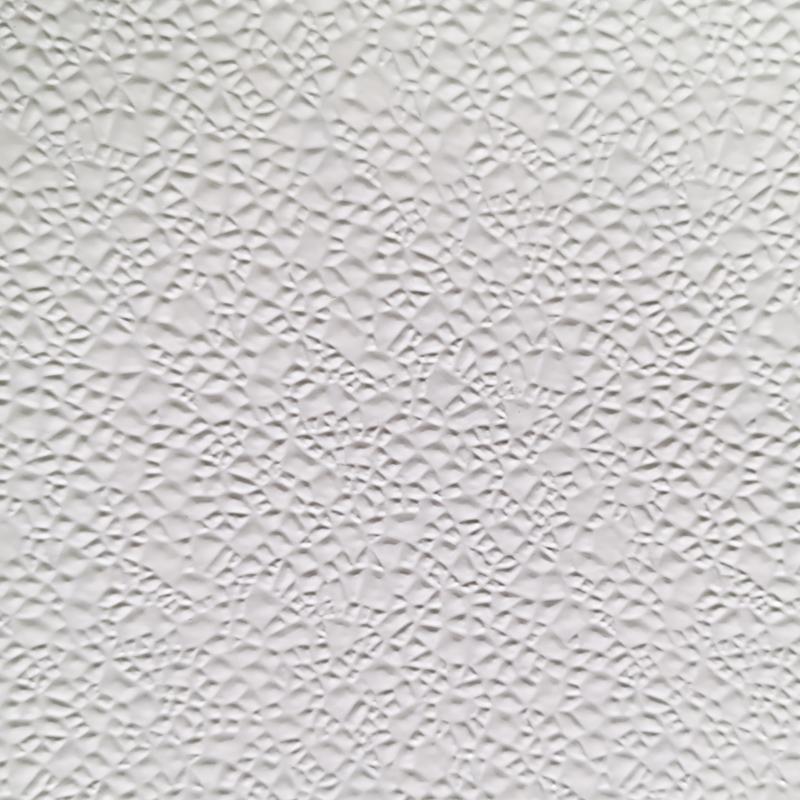
Incubator rooms rarely conform to standard sheet dimensions. Wall elevations are interrupted by plenums, duct penetrations, door frames, view windows, and equipment pass-throughs. Supplying Pebbled FRP Sheet in rolls—typically 100 meters per roll in the industry standard —gives the installer the ability to cut each wall run as a continuous length, eliminating the horizontal butt joints that accumulate soil and require sealant maintenance.
LZ Panels ships rolls at the specified thickness, with the customer’s wall schedule determining the cut plan. For projects where on-site cutting introduces schedule risk or where the installing contractor prefers factory-controlled edges, we also pre-cut panels to exact dimensions. The decision between roll supply and pre-cut sheet is logistical, not technical: the same resin system, gelcoat, and pebbled embossing are used in both formats.
White is the standard color for incubator room interiors because it maximizes light reflectance and simplifies visual inspection. LZ Panels can produce Pebbled FRP in custom colors matched to a RAL or equivalent reference when a facility specifies color-coding by zone or wishes to match existing equipment housings.
A fiberglass wall panel is only as sanitary as its edges. The cut edges of Pebbled GRP expose the glass reinforcement, which can wick moisture if left unsealed. The accessory system is therefore not optional trim—it is the moisture barrier that completes the installation.
LZ Panels supplies PVC profiles matched to the panel thickness:
H Divider: Used at vertical and horizontal panel-to-panel joints where two cut edges meet. The H profile encapsulates both edges, removing the need for wet sealant at the joint and allowing for the slight dimensional movement that occurs as the room cycles between ambient and operating temperature.
J Trim: Used at perimeters—floor, ceiling, inside corners, and around openings. The J profile provides a finished edge and a mechanical stop for sealant application where the panel meets dissimilar substrates.
Inside and Outside Corners: Pre-formed PVC angles that eliminate the need to miter panel edges at room corners, a detail that is difficult to execute cleanly with fiberglass roll goods and is a common failure point for moisture intrusion.
For projects specifying Pebbled FRP 2.3mm or Pebbled FRP 1.9mm, the accessory profiles are sized to the corresponding panel thickness so that the trim sits flush with the finished face. Using mismatched trim is a frequent source of callbacks: an H divider sized for 2.5mm will not grip a 1.9mm panel securely, leaving a gap that defeats the purpose of the edge seal.

Can Pebbled FRP Sheet for Incubator Room be installed directly over existing tile or painted block?
Adhesive bonding requires a clean, sound, and dimensionally stable substrate. Glossy tile and sealed concrete block must be abraded or primed to achieve reliable adhesion with FRP-rated adhesive. If the existing surface has loose paint, efflorescence, or visible moisture staining, mechanical removal or furring is recommended before panel installation. The pebbled face does not compensate for substrate movement; the panel will telegraph underlying defects if the wall is not flattened first.
Does the pebbled texture make the wall harder to disinfect?
No. The embossing depth is shallow enough that a low-pressure rinse and standard hatchery disinfectant contact time are sufficient. The texture does not create blind holes or undercuts; it is a continuous gelcoat surface with a fine orange-peel topography. In practice, the pebbled surface is easier to clean than a deeply textured block wall and comparable to smooth FRP in routine sanitation, with the added benefit of showing less post-clean streaking.
What is the maximum roll length available, and how are the rolls packed for export?
Standard production is 100 meters per roll, with roll width determined by the panel specification. Rolls are wound on cores and protected with interleaving film to prevent surface abrasion in transit. LZ Panels exports to international hatchery and agricultural projects; packing specifications and container loading plans are provided at quotation stage based on the project’s total square meterage and cut plan.
Can I mix 2mm and 2.3mm panels on the same wall elevation?
Yes, provided the transition is handled with the correct accessory. A step in panel thickness at a horizontal joint requires a transition profile or a back-to-back J trim arrangement. In practice, most projects specify a single thickness per wall plane to simplify trim procurement and installation labor. Where impact risk varies—for example, a low wall section behind trolley parking versus an upper wall section—a thickness transition may be justified, but it should be detailed before panels are cut.
Is Pebbled GRP suitable for the exterior walls of a modular hatchery building?
The standard pebbled roll product is formulated for interior service. Exterior applications require a UV-stabilized gelcoat or a topcoat system appropriate for continuous solar exposure. LZ Panels can discuss UV-resistant variants for projects where the FRP serves as an exterior cladding or where the incubator room walls are part of a prefabricated module exposed to weather during transport and installation.
LZ Panels is a Chinese manufacturer of fiberglass-reinforced plastic sheet and panel products, producing flat and embossed FRP/GRP in roll and sheet formats for agricultural, food processing, and controlled-environment construction. Our Pebbled FRP Sheet for Incubator Room interiors is manufactured to consistent thickness and gelcoat standards, with white as the standard color and custom color matching available against project references. We supply the full accessory range—H dividers, J trims, corners, and sealants—as a coordinated package so that the installed system performs as a continuous moisture barrier rather than a collection of mismatched components.
For projects requiring Pebbled GRP in 1.9mm, 2mm, or 2.3mm, LZ Panels provides cut-to-size or roll supply with export documentation and loading plans matched to the installation schedule. Technical data sheets, color samples, and trim profile drawings are available on request.
Contact us:
Email: lzpanels@163.com
WhatsApp/Wechat: +8613702432446


