
- All
- Product Name
- Product Keyword
- Product Model
- Product Summary
- Product Description
- Multi Field Search
 |


| Quantity: | |
|---|---|
In the world of modern industrial and construction materials, innovation is key to achieving durability, efficiency, and versatility. Among the front-runners in this arena are Glass Fiber Reinforced Plastic (GFRP) sheets supplied in continuous rolls. Specifically, Black, Beige, Blue, Grey, and White GFRP sheet in roll formats have become indispensable for fabricating high-performance composite sandwich panels. These panels are the backbone of critical structures, from temperature-controlled transportation to dynamic architectural designs. This comprehensive guide delves into the specifics of gfrp sheet roll products, their applications with core materials like XPS, PU, and EPS, and why choosing the right color—such as a white gfrp sheet for reflectivity or a black gfrp sheet for aesthetic blending—is crucial for project success. We will explore how gfrp sheet for composite panel and gfrp sheet for sandwich panel manufacturing is revolutionizing industries by offering unmatched strength-to-weight ratios, corrosion resistance, and design flexibility.
A gfrp sheet is a composite material formed by embedding glass fibers into a polymer resin matrix, typically polyester, vinyl ester, or epoxy. This combination yields a product that is remarkably strong, lightweight, and resistant to environmental degradation. When produced in a continuous gfrp sheet roll, the material offers significant advantages for large-scale production, allowing for seamless lamination over vast areas without unsightly joints or weak points. The process of creating gfrp sheet in roll involves pultrusion or continuous lamination, ensuring consistent thickness, fiber alignment, and mechanical properties throughout the length of the roll. This consistency is paramount when the material is destined to become a gfrp sheet for sandwich panel, where it will serve as the durable, protective skin.
The popularity of gfrp sheet for composite panel construction stems from its exceptional properties:
High Strength and Stiffness: The glass fiber reinforcement provides tensile strength comparable to steel at a fraction of the weight.
Lightweight: Essential for transportation applications like truck bodies where payload is critical.
Excellent Corrosion Resistance: Unlike metals, GFRP does not rust or corrode when exposed to moisture, chemicals, or road salts.
Dimensional Stability: It maintains shape and size under varying thermal and moisture conditions.
Ease of Fabrication: Gfrp sheet in roll can be easily cut, shaped, and laminated onto core materials on-site or in a factory.
Aesthetic and Functional Colors: The availability of pigments allows for integral coloring. A white gfrp sheet offers high solar reflectance, a grey gfrp sheet provides a neutral industrial look, a blue gfrp sheet can signify cold storage or brand identity, a beige gfrp sheet blends with architectural finishes, and a black gfrp sheet delivers a sleek, modern appearance.
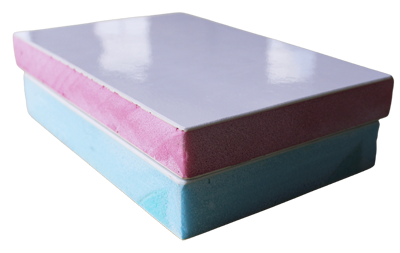
One of the most demanding applications for gfrp sheet for sandwich panel is in the manufacturing of refrigerated truck (reefer) and dry freight van bodies. Here, the composite sandwich panel, with a gfrp sheet skin, is bonded to an insulating core.
Core Materials: The gfrp sheet roll is typically laminated to Polyurethane (PU) foam, Extruded Polystyrene (XPS), or Expanded Polystyrene (EPS). PU offers the best insulation (lowest k-value), XPS provides high compressive strength and moisture resistance, while EPS is a cost-effective option.
Benefits: The resulting panel is incredibly strong, thermally efficient, and lightweight. The smooth, non-porous surface of the gfrp sheet is easy to clean, hygienic, and resistant to impacts and the harsh cleaning chemicals used in the food transport industry. Choosing a white gfrp sheet for the interior of a refrigerated truck enhances brightness and helps with temperature management.
Beyond transportation, the versatility of gfrp sheet for composite panel systems is exploited in architecture.
Building Wall Partitions and Cladding: These panels are used for interior and exterior walls, cleanroom partitions, and sanitary enclosures. The gfrp sheet surface is impervious to mold, mildew, and moisture, making it ideal for wet environments like bathrooms, kitchens, and food processing plants.
Aesthetic Flexibility: Architects can specify a black gfrp sheet for a bold, contemporary facade, a beige gfrp sheet to complement natural stone or brick, a blue gfrp sheet for accent features, or a standard grey gfrp sheet for utilitarian structures. The color is molded in, so it won't fade, peel, or require painting.
Structural Insulated Panels (SIPs): For rapid building construction, gfrp sheet roll material laminated to foam cores creates strong, well-insulated wall and roof systems.
For applications requiring extreme lightness and high shear strength, such as in aerospace-inspired designs or lightweight interior partitions, gfrp sheet for sandwich panel is bonded to honeycomb cores (aluminum, Nomex, or polypropylene). The gfrp sheet skin provides the facing that stabilizes and transmits loads to the honeycomb structure, creating an exceptionally stiff panel.
The white gfrp sheet is perhaps the most common variant. Its high reflectivity helps in reducing heat absorption in trailers and buildings, contributing to thermal efficiency. In interior spaces, it creates a bright, clean, and hygienic appearance, which is why it's frequently specified for冷藏车 (refrigerated truck) interiors, cold rooms, and sanitary wall linings.
The grey gfrp sheet offers a neutral, professional look that is less prone to showing minor scuffs or dust. It is a popular all-purpose choice for干式车厢 (dry freight van) interiors, industrial enclosures, and architectural elements where a subdued, non-reflective finish is desired.
Often used in specialized industries, the blue gfrp sheet can serve as a visual indicator. It might designate panels for specific temperature zones, align with a company's branding, or simply provide a visually appealing alternative to standard colors in architectural designs.
The beige gfrp sheet is tailored for architectural applications where blending with traditional materials like sand, stone, or concrete is important. It provides a warmer, less industrial aesthetic than grey or white, making it suitable for building facades, interior feature walls, and partitions in offices or public buildings.
A black gfrp sheet delivers a sleek, high-end, and modern appearance. It is often chosen for architectural cladding, high-design interior spaces, or exterior applications where a bold statement is intended. High-quality black pigments also offer good UV stability, preventing degradation from sunlight.
The process of transforming a gfrp sheet roll into a finished sandwich panel is precise and critical for performance.
Core Preparation: The XPS, PU, or EPS foam block (or honeycomb slab) is cut to size and its surface is cleaned.
Adhesive Application: A structural adhesive, often a two-part polyurethane or epoxy, is evenly applied to the core surface.
Unrolling and Layering: The gfrp sheet in roll is unrolled and carefully laid onto the adhesive-coated core.
Pressing and Curing: Pressure is applied using a vacuum bag, press, or roller system to remove air bubbles and ensure full contact. The assembly is left to cure as per the adhesive specifications.
Finishing: Once cured, the panel is trimmed to final dimensions. The process is repeated on the opposite side to create the complete sandwich structure.
Using a dedicated gfrp sheet for sandwich panel lamination is optimal because the sheets are engineered with the correct resin chemistry and surface treatment to achieve maximum bond strength with the core adhesive. This ensures the panel acts as a unified structural component, a principle known as composite action, where the skins carry tension and compression, and the core manages shear forces.

Selecting the appropriate gfrp sheet in roll involves several factors:
Mechanical Requirements: Define the needed tensile, flexural, and impact strength.
Environmental Exposure: Consider exposure to UV, chemicals, moisture, and temperature extremes. This may influence resin type (e.g., iso-polyester for better UV resistance).
Color Choice: Decide based on function (reflectivity, hygiene) or aesthetics. Whether you need a black gfrp sheet for looks or a white gfrp sheet for performance, the pigment must be of high quality.
Roll Dimensions: Consider width, length, and thickness to minimize waste.
Source your gfrp sheet roll from reputable manufacturers who provide technical data sheets and certifications. Inspect rolls for consistency in color, thickness, and surface finish. The integrity of the gfrp sheet is the foundation of your composite panel's performance.
The evolution of composite materials has positioned Black, Beige, Blue, Grey, and White GFRP sheet in roll as a cornerstone technology for the transportation and construction industries. As a premier gfrp sheet for composite panel and gfrp sheet for sandwich panel fabrication, it delivers an unmatched combination of strength, lightness, durability, and design freedom. From the clean interior of a冷藏车 clad in a white gfrp sheet to the striking facade of a building featuring a black gfrp sheet, the applications are boundless. Understanding the properties, colors, and lamination processes associated with gfrp sheet roll products empowers engineers, fabricators, and architects to make informed decisions, pushing the boundaries of what is possible in creating efficient, sustainable, and visually compelling structures. By investing in high-quality gfrp sheet in roll, you are investing in the future of innovative composite solutions.
Contact us:
Email: lzpanels@163.com
WhatsApp/Wechat: 008613702432446


