
- All
- Product Name
- Product Keyword
- Product Model
- Product Summary
- Product Description
- Multi Field Search
 |


| Quantity: | |
|---|---|
In the dynamic world of commercial road transport, efficiency, durability, and total cost of ownership are the holy grail for fleet operators. While traditional materials like aluminum and steel have long been the standard, a sophisticated composite solution has been steadily revolutionizing lorry body construction: the Fiberglass Reinforced Plastic panel, commonly known as the FRP lorry panel or GRP lorry panel. This article moves beyond basic material properties to explore the strategic, design-led revolution these panels are enabling. We will delve into how the very format of these panels—supplied as flat, versatile sheets—is unlocking unprecedented levels of efficiency and customization for both dry freight and refrigerated applications, fundamentally changing how lorry bodies are conceived and built.
To truly appreciate the value of a fiberglass lorry body panel, one must look past it as a mere sheet of material and understand it as the foundational component of a highly engineered system. Its core identity is defined by its composite nature—a synergy of glass fibers embedded in a polymer resin matrix. This union creates a material with a strength-to-weight ratio that outperforms many metals, but the strategic genius lies in its application methodology.
Unlike pre-formed body sections, the standard GRP lorry panel is supplied as a flat sheet. This is a deliberate and powerful design choice. It serves as a blank canvas for manufacturers, allowing them to engineer the final body properties by selecting the appropriate core material. This decoupling of the outer skin from the structural and insulating core is what grants unparalleled flexibility. The flat fiberglass lorry panel is not a finished product; it is a premium raw material for creating a tailored solution, enabling everything from ultra-lightweight dry vans to highly efficient refrigerated units.
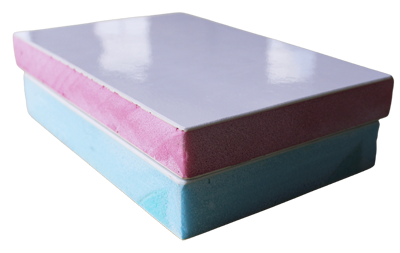
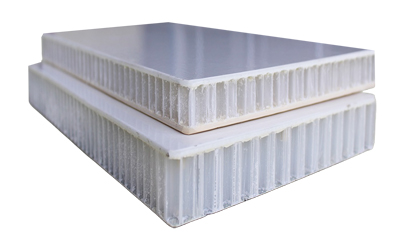
The true potential of a flat FRP lorry body panel is realized when it is laminated to a core material, creating a composite sandwich panel. This process allows for precise engineering:
For Dry Vans: The panel can be bonded to lightweight cores like honeycomb or foam, creating a rigid, damage-resistant, and incredibly light body that maximizes payload capacity.
For Reefers: When the same FRP lorry panel is bonded to a thick layer of high-performance insulation foam (such as PU or PIR), it forms the airtight, thermally efficient walls of a refrigerated unit. The non-porous, seamless surface of the GRP prevents moisture ingress and protects the insulation's integrity.
A pivotal, yet often overlooked, aspect of the modern fiberglass lorry body panel is its availability in coil form. This logistical innovation has profound implications for manufacturing efficiency and material performance.
Supplying GRP lorry panels in large coils transforms the workflow for body builders. Instead of handling and storing countless individual sheets, manufacturers can install a continuous coil line. This allows for on-demand, precision cutting of panels to exact lengths, drastically reducing material waste and handling time. This just-in-time manufacturing approach minimizes storage space requirements, reduces the risk of panel damage, and accelerates overall production cycles, leading to significant cost savings that can be passed down the supply chain.
Panels cut from a continuous coil offer superior consistency. There are no end-to-end joints or seams in the outer skin over the length of the body, which is a common point of failure and aesthetic inconsistency in traditional construction. This results in a cleaner, more uniform appearance and a structurally more reliable body, as the risk of leaks or weak points at panel joints is eliminated.
While functionality is paramount, the visual and practical aspects of colour play a significant role in the specification of a GRP lorry body panel.
The prevalence of white and grey is not an arbitrary choice. White, in particular, is the standard for refrigerated and many dry freight applications due to its high Solar Reflectance Index (SRI). A white FRP lorry panel reflects a substantial portion of solar radiation, significantly reducing heat absorption. This lowers the internal temperature of a dry van, protecting sensitive cargo, and drastically reduces the thermal load on a reefer's refrigeration unit, leading to substantial fuel savings. Grey offers a professional aesthetic with similar, though slightly less pronounced, reflective properties.
The manufacturing process of a fiberglass lorry panel allows for a virtually unlimited palette of custom colours. This enables fleet operators to seamlessly integrate their corporate branding directly onto the bodywork, turning a functional asset into a mobile billboard. Furthermore, specific colours can be chosen for functional reasons in specialized applications, such as non-standard safety requirements or specific environmental conditions.

The efficiency of a lorry body build is heavily dependent on the availability of panels in precise, industry-standard widths. This allows for optimal material usage with minimal cutting and waste. The most common and critical widths are detailed below, each serving a specific purpose in the structural and aesthetic design of the vehicle.
The 2000mm GRP lorry panel is a fundamental building block in the industry. Its width makes it exceptionally versatile for constructing various body sections, including side walls, front headers, and door frames on a wide range of medium and rigid body trucks. It offers an excellent balance between manageability and coverage, reducing the number of vertical joins required.
Stepping up in size, the 2200mm GRP lorry panel is a popular choice for maximizing the seamless appearance and structural integrity of larger side panels. By using a wider panel, manufacturers can create taller body sides with fewer horizontal seams. This not only enhances the visual appeal but also reduces potential leak paths and strengthens the overall body structure.
For high-cube trailers and bodies where internal volume is paramount, the 2400mm GRP lorry panel is often the go-to specification. Its substantial width allows for the construction of very tall, single-piece side panels that are both imposing and highly efficient. The reduction in seams translates directly into a smoother exterior, improved aerodynamics, and a faster, cleaner build process for the manufacturer.
At the top of the standard range sits the 2600mm GRP lorry panel. This width is a cornerstone for the construction of full-sized semi-trailers and curtain-siders across Europe and beyond. It is engineered to provide the maximum possible uninterrupted surface area, facilitating the rapid assembly of large-volume bodies. The use of a 2600mm GRP lorry panel is a direct commitment to achieving the highest levels of manufacturing efficiency and final product quality for the largest class of freight vehicles.
The fiberglass lorry body panel is far more than a simple alternative to metal. It represents a paradigm shift in commercial vehicle body construction. Its identity as a flat, coil-supplied, composite-ready material positions it as a strategic asset for forward-thinking fleet operators and body builders. From the thermal efficiency of its white finish to the manufacturing precision enabled by standard widths like the 2400mm GRP lorry panel and 2600mm GRP lorry panel, every aspect is designed for performance and economy. By choosing a high-quality FRP lorry body panel, one is not just selecting a material; one is investing in a system that delivers lower lifetime costs, greater payload potential, enhanced durability, and a superior return on investment, solidifying its place as the intelligent choice for the future of transport.
Contact us:
Email: lzpanels@163.com
WhatsApp/Wechat: 008613702432446


