
- All
- Product Name
- Product Keyword
- Product Model
- Product Summary
- Product Description
- Multi Field Search
 |


| Quantity: | |
|---|---|
Welcome to the next generation of composite engineering. Our premium Fiberglass (FRP/GRP) Sheet is specifically engineered as the ideal surface layer (skin) for sandwich panels. Whether you are manufacturing architectural cladding for outdoor building facades, durable interior wall partitions, or lightweight yet rugged truck trailer bodies, this product delivers unmatched performance.
By utilizing Unsaturated Polyester Resin combined with either Chopped Strand Mat (CSM) or Woven Roving (WR) , this sheet provides a perfect balance of rigidity, impact resistance, and environmental durability.
Sandwich panels rely on the "I-beam" principle: a lightweight core (such as PU foam, XPS, honeycomb, or balsa) handles shear loads, while the stiff, strong skins handle compression and tension. Our Fiberglass Sheet for Sandwich Panel applications offers significant advantages over traditional materials like steel, aluminum, or plywood.
At the heart of this product is the Unsaturated Polyester Resin matrix. Why does this specific resin dominate the composites industry for sandwich panel skins?
Cost-Effectiveness: Compared to epoxy or vinyl ester resins, unsaturated polyester offers the best strength-to-cost ratio for large-scale architectural and transportation projects.
Excellent Mechanical Properties: It provides high tensile strength, flexural modulus, and impact resistance—critical when the panel surface faces daily wear, forklift bumps (in trailers), or accidental impacts (on walls).
Superior Weathering & Chemical Resistance: When properly formulated with UV inhibitors, a FRP Sheet with Unsaturated Polyester Resin resists degradation from sunlight, rain, salt spray (marine environments), and common industrial chemicals. It does not rust or corrode like metal.
Thermal Stability: The resin matrix maintains its shape and mechanical integrity across a wide temperature range (-40°C to +80°C), preventing warping in hot sun or brittleness in freezing cold storage units.
Ease of Bonding: The chemical nature of unsaturated polyester allows exceptional secondary bonding. When laminating a GRP Sheet with Unsaturated Polyester Resin to a foam or honeycomb core, the same resin system can act as the adhesive, creating a monolithically bonded sandwich structure without delamination.

To meet varying application demands, we offer two distinct reinforcement architectures. The choice between a Fiberglass Sheet with Chopped Strand Mat and a Fiberglass Sheet with Woven Roving fundamentally changes the mechanical behavior of your sandwich panel. Below we break down the differences, benefits, and ideal use cases for each.
An FRP Sheet with Chopped Strand Mat features randomly oriented, discontinuous fiberglass strands held together by a binder. This is the most versatile and commonly used reinforcement for general-purpose sandwich panels.
Isotropic Strength: Because the fibers are randomly distributed, the sheet exhibits approximately equal mechanical properties in all directions (machine direction vs. cross direction). This simplifies engineering for curved panels or complex loads.
High Resin Absorption: CSM has a fluffy, high-void volume texture, which allows it to saturate completely with unsaturated polyester resin. This produces a thick, resin-rich surface that is excellent for secondary bonding.
Thick Build for Low Cost: You achieve a higher thickness per ply compared to woven fabrics at a lower material cost.
Excellent Impact Dampening: The random fiber arrangement effectively disperses point impact energy, preventing crack propagation.
Indoor Wall Partitions: In clean rooms, food processing plants, or commercial kitchens, a GRP Sheet with Chopped Strand Mat provides a smooth, non-porous, washable surface. The isotropic strength ensures the panel withstands accidental cart bumps and pressure washing.
Outdoor Building Facades (Rain Screens): For architectural cladding, the thick resin-rich surface of a CSM sheet offers superior UV and moisture resistance, preventing water ingress behind the facade.
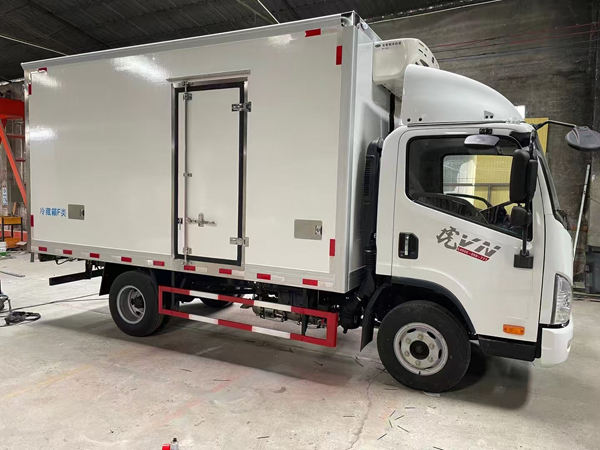
Refrigerated Trucks (Internal Liners): The slightly textured backside of a CSM lamination bonds exceptionally well to PU foam, creating the structural floor and walls of a reefer trailer. The isotropic strength resists the "spalling" effect from shifting cargo.
Horse Stall Partitions: The non-corrosive, easy-to-clean nature paired with impact resistance makes CSM sheets ideal for agricultural indoor walls.

A GRP Sheet with Woven Roving is produced by weaving continuous fiberglass roving strands in a classic over-under pattern (plain, twill, or satin weave). This creates a fabric with distinct warp (0°) and weft (90°) orientations. When laminated with unsaturated polyester resin, this becomes a high-performance, load-bearing skin.
Anisotropic (Directional) Strength: You can achieve up to 5x higher tensile and flexural strength in the 0° and 90° fiber directions compared to CSM. The strength is precisely where you design it.
Higher Fiber-to-Resin Ratio: Woven roving packs more glass fiber into a given thickness. This results in a stiffer, stronger, and lighter laminate than CSM for the same thickness.
Excellent Flexural Modulus: WR laminates resist bending under load far better than CSM. This is critical for large-span panels.
Wear & Abrasion Resistance: The continuous, unbroken fiber bundles on the surface provide superior resistance to scratching and gouging compared to chopped strands.
Dry Freight & Dump Truck Sidewalls: A FRP Sheet with Woven Roving used as the exterior skin on a dump truck body resists the denting and flexing that occurs when loading gravel or scrap metal. The directional strength prevents "oil-canning" (visible flexing).
Structural Roof Panels for Shelters: When spanning 8-10 feet between purlins, a sandwich panel with a Fiberglass Sheet with Woven Roving skin will not sag under snow load or wind uplift. The high modulus of elasticity is essential here.
Platforms & Walkways: For industrial mezzanines or trench covers, the WR skin provides the stiffness needed for foot traffic and light forklift use without permanent deflection.
High-Impact Exterior Facades: In hurricane-prone regions, architectural sandwich panels with woven roving skins can pass missile-impact tests (e.g., large timber 2x4 at 50 mph) that CSM skins would fail.

For many professional sandwich panel manufacturers, the solution is not "either/or" but "both." You can order custom laminates that use a Fiberglass Sheet with Chopped Strand Mat as the surface veil (to provide a smooth, resin-rich, UV-stable finish) backed by one or two plies of Fiberglass Sheet with Woven Roving for structural backbone. This hybrid approach gives you:
A beautiful, paintable, gel-coatable surface (from the CSM layer).
High flexural and impact strength (from the WR layer).
Excellent interlaminar shear strength between the hybrid layers.
Our FRP Sheet with Unsaturated Polyester Resin is manufactured via continuous lamination (machine-made) or hand lay-up (for custom thicknesses), ensuring consistent quality.
| Parameter | CSM Grade (Standard) | WR Grade (Heavy Duty) |
|---|---|---|
| Reinforcement Type | Chopped Strand Mat (450 g/m² or 600 g/m²) | Woven Roving (800 g/m² to 1200 g/m²) |
| Resin Content | 65-70% (Resin-rich) | 45-55% (Fiber-rich) |
| Typical Thickness | 1.0 mm to 4.0 mm | 1.5 mm to 6.0 mm |
| Tensile Strength (MPa) | 80 - 120 | 250 - 350 (in weave direction) |
| Flexural Modulus (GPa) | 6.0 - 7.5 | 10.0 - 15.0 |
| Standard Widths | Up to 3,100 mm | Up to 3,100 mm |
| Standard Colors | White, Gray, Beige, Custom RAL | White, Natural Translucent, Custom RAL |
| Surface Finish | Matte, Embossed (leather grain), Glossy | Matte, Satin, or Orange Peel |
Challenge: The panel must resist wind load, rain, UV radiation, and temperature swings while looking aesthetic.
Solution: For most commercial facades, a GRP Sheet with Chopped Strand Mat is sufficient. The resin-rich surface provides a water-tight barrier. However, for the ground floor (where people might kick the panel or where a cart could hit it) or in high-wind zones, specify a GRP Sheet with Woven Roving for the exterior skin. The interior skin (facing the insulation) can always be CSM to save cost.
Challenge: Walls must be smooth, non-shedding, easy to clean with harsh detergents, and resistant to condensation and mold.
Solution: Unquestionably, choose a Fiberglass Sheet with Chopped Strand Mat. The random fiber arrangement prevents "fiber print" (fibers telegraphing through the surface), leaving a perfectly smooth surface. This prevents bacterial growth in food plants. For cold storage (-20°C freezer walls), the isotropic properties of CSM prevent thermal-stress cracking.
Challenge: The cargo area experiences point loads (lift truck wheels), abrasion (sliding boxes), and dynamic flexing (twisting of the trailer frame).
Solution: This is the prime use case for FRP Sheet with Woven Roving. When building a semi-trailer sidewall, the WR skin provides the "hoop strength" needed to contain the cargo load during cornering. For floors, a very thick WR laminate (4-6 mm) is used as the top skin over a high-density foam core, creating a floor that weighs 60% less than aluminum but lasts twice as long. A Fiberglass Sheet with Woven Roving will not dent like steel when forklifts turn on it.
While some may ask about vinyl ester or epoxy, the FRP Sheet with Unsaturated Polyester Resin remains the industry gold standard for three reasons:
Processing Speed: Polyester resins cure faster than epoxies. In a continuous sandwich panel production line (double-belt laminators), a faster cure time equals higher linear output per hour.
Adhesion to Common Cores: Polyester resin chemically welds to polyurethane (PU) foam and extruded polystyrene (XPS). Epoxy does not bond well to PU foam without a special primer. With our GRP Sheet with Unsaturated Polyester Resin, you simply apply a fresh layer of the same resin as your bonding adhesive.
Repairability: If a truck wall or building facade is damaged on site, polyester-based repair kits are cheap, readily available, and bond perfectly to the existing skin. Epoxy repairs on polyester surfaces often fail.
Absolutely. The FRP Sheet with Unsaturated Polyester Resin accepts high-quality acrylic or polyurethane paints after light sanding. For architectural use, we recommend adding a UV-stable gelcoat during manufacturing (available upon order).
For floors, you need both compression resistance and abrasion resistance. A Fiberglass Sheet with Woven Roving (thick, 3mm+) is mandatory. The woven roving provides the compressive strength to prevent the forklift wheels from "punching through" the foam core.
We recommend a two-part epoxy adhesive or a film adhesive for honeycomb. While our FRP Sheet with Chopped Strand Mat has a good bonding surface, honeycomb requires a gap-filling adhesive. We can supply the sheets with a peel-ply backing to create a pristine bonding surface.
Standard GRP Sheet with Unsaturated Polyester Resin is not UV stable for decades. However, we offer an "ISO-NPG" grade resin (Isophthalic-Neopentyl Glycol) that provides excellent UV resistance and hydrolytic stability suitable for 20+ years of outdoor building facades. Please specify this when ordering.
We understand that every sandwich panel manufacturer has unique requirements. We do not offer "one-size-fits-all." When you inquire about our FRP Sheet with Unsaturated Polyester Resin, please provide the following:
Desired Reinforcement: Pure CSM, Pure WR, or Hybrid (CSM surface + WR core).
Thickness: From 0.8 mm (light indoor) to 6.0 mm (heavy duty flooring).
Width & Length: Rolled goods (50m to 150m rolls) or cut sheets (standard 4ft x 8ft, 4ft x 10ft, or metric 2500mm x 1250mm).
Resin Type: Orthophthalic (economy indoor), Isophthalic (water/chemical resistance), or Fire Retardant.
Color & Texture: White smooth-matte (most common), leather-grain (anti-slip for floors), or custom RAL color with gelcoat.
From the rugged highways where trucks carry our nation's goods, to the sterile walls of pharmaceutical clean rooms, and the striking facades of modern architecture—the Fiberglass (FRP/GRP) Sheet made with Unsaturated Polyester Resin is the proven, reliable solution.
By understanding the difference between a Fiberglass Sheet with Chopped Strand Mat (for isotropic strength, smooth finish, and bonding) and a Fiberglass Sheet with Woven Roving (for directional, high-stiffness, load-bearing capacity), you can precisely engineer your sandwich panel for its end-use environment.
Do not settle for metal that rusts, corrodes, or dents. Upgrade to the future of composites.
[Request a Quote Today] – Tell us your core material (PU foam, XPS, honeycomb) and your mechanical loading requirements, and our engineers will recommend the optimal FRP Sheet with Unsaturated Polyester Resin grade for your project.
Contact information:
Email: lzpanels@163.com
WhatsApp/Wechat: +8613702432446


